Yellow-billed Cuckoo
Description
The yellow-billed cuckoo (Coccyzus americanus) is a cuckoo. Common folk-names for this bird in the southern United States are rain crow and storm crow. These likely refer to the bird's habit of calling on hot days, often presaging rain or thunderstorms.
Distribution & Habitat
The Yellow-billed Cuckoo occurs from the United States
through South America
including the West Indies,
where one population consists
of uncommon to rare breeding
residents from May to August on
Cuba, Hispaniola, Puerto Rico,
Jamaica, and the Virgin Islands (Raffaele and others 1998).
Another population migrates
south from North America
during September and October
and returns to the north during
March and April (Raffaele and
others 1998). As a migrant, it is
common in the southern part of
The Bahamas, Cuba, Hispaniola,
and Puerto Rico, while it is
uncommon in the northern part
of The Bahamas, the Cayman
Islands, and Jamaica, and rare
in the Virgin Islands (Raffaele
and others 1998). It is described
as a rare passage migrant in
spring, and extremely rare in
summer and fall on Vieques
(Gemmill 2015). However, during
migration and winter it can be found anywhere in the islands.
This species usually inhabits
dry forests and lowland scrub
(Raffaele and others 1998), and
it mostly occurs in dry coastal
regions in Puerto Rico (Biaggi
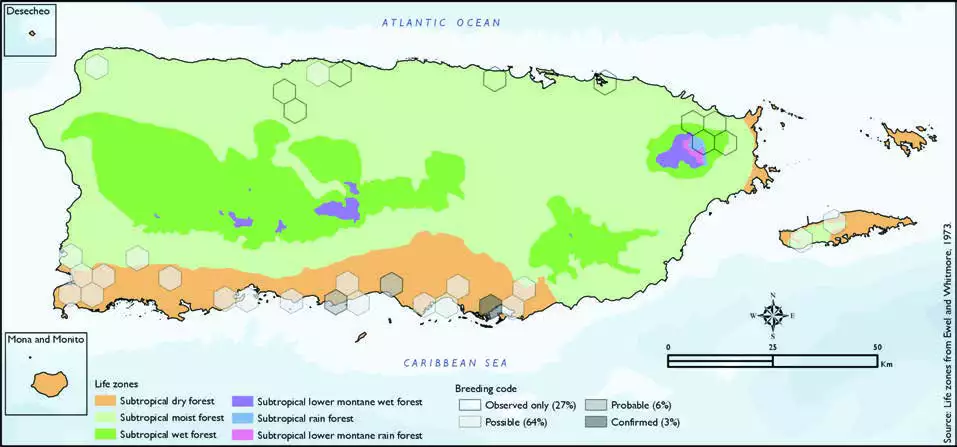
1997). The atlas fieldwork
yielded a total of 44 records
within 33 hexagons or 7 percent
of the 479 total hexagons (see
map). Of the 33 hexagons where
this species was found, breeding
met the atlas definition of
confirmed in 3 percent (1) of the
hexagons, probable in 6 percent
(2), and possible in 64 percent
(21), while the species was
observed in 27 percent (9) of the
hexagons but without evidence
of breeding (see map). Yellow-billed Cuckoo distribution. The map shows the highest breeding code by hexagon and overlaying the ecological life zones in
Puerto Rico. Note: percentages may not total 100 due to rounding. 69Yellow-billed Cuckoo/Pájaro Bobo Piquiamarillo
Breeding Habits
The Yellow-billed Cuckoo builds a cup-shaped nest made of twigs
and dried grass, which is usually
placed low in a bush (Raffaele
and others 1998). Previously
published reports indicate that
it breeds from April to July
(Raffaele and others 1998). Atlas
results show that this species
breeds mostly from April to
August, with one record each in
February and November, and a
peak in May (see chart). Results show that this species breeds
mostly within the subtropical
dry forest life zone (79 percent
of the hexagons) (see table), but
it may also breed in subtropical
moist forests (21 percent of the
hexagons) (see table and map).
Conservation
The current population trend of the Yellow-billed Cuckoo is
described as decreasing in North
America (BirdLife International
2016, Butcher and Niven 2007). This species is currently listed
as a species of Least concern by
the IUCN (BirdLife International
2016). Locally, this species is not
listed in any of the threatened
categories of PRDNER and
USFWS. In Puerto Rico, the
Yellow-billed Cuckoo has a
protected habitat in land of 10
percent or 58 km2 of the total area covered by the hexagons
where evidence of breeding was
found for this species (575 km2).
Related Species
Family:
cuckoo