Common Ground-Dove
Description
The common ground dove (Columbina passerina) is a small bird that inhabits the southern United States, parts of Central America, the Caribbean and northern South America. It is considered to be the smallest dove that inhabits the United States. As its name suggests, the bird spends the majority of its time on the ground walking but still has the ability to fly.
The common ground dove is North America's smallest dove and is one of the world's smallest by mass. This species ranges from 15–18 cm (5.9–7.1 in) in length, spans 27 cm (11 in) across the wings and weighs 26–40 g (0.92–1.41 oz). The common ground dove has a yellow beak with a black tip. Feathers surrounding the beak are pink in colour. The feathers on the head and the upper breast have a scale like appearance. The tail feathers are very short and similar colour to the back. The plumage on the back of the bird is brown. The coverts and wing feathers are also brown but have black spotting on them. The common ground dove has chestnut primaries and wing borders, which can only been seen when the bird is flying. The common ground dove shows some sexual dimorphism in their plumage. The males have slate gray feathers on the top of their heads and pink-gray colouration on their belly. Females on the other hand are more gray than their male counterparts and are more evenly coloured.
Distribution & Habitat
The Common Ground-Dove occurs through the Southern
United States, Mexico, Central
America, and northern South
America including the West
Indies (Raffaele and others
1998). It is a year-round and
very common resident in Puerto
Rico (Raffaele and others
1998), Culebra, Mona (Ventosa-
Febles and others 2005), and
Vieques islands (Gemmill 2015).
Puerto Rico and its satellite
islands harbor an endemic
subspecies (C. p. portoricensis),
with the exception of Mona,
which has another subspecies (C. p.fiexigua). The Common
Ground-Dove uses a wide range
of lowland habitats (Raffaele
and others 1998) including forest
edges, farms, open country,
gardens, and towns (Oberle
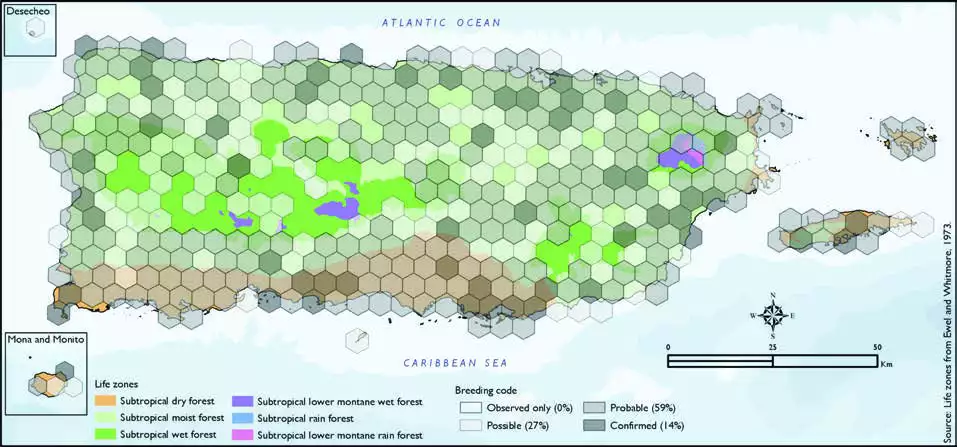
2018). The atlas fieldwork
yielded a total of 861 records
within 378 hexagons or 80
percent of the 479 total hexagons
(see map). Of the 378 hexagons
where this species was found,
breeding met the atlas definition
of confirmed in 14 percent (53)
of the hexagons, probable in 59
percent (223), and possible in 27
percent (102) (see map). Common Ground-Dove distribution. The map shows the highest breeding code by hexagon and overlaying the ecological life zones
in Puerto Rico. Note: percentages may not total 100 due to rounding. 53Common Ground-Dove/Rolita
Breeding Habits
The Common Ground-Dove builds a nest made of rootlets,
grasses, or twigs in a shrub
or tree, or on the ground.
Previously published reports
indicate that it breeds year-
round, but breeding peaks
during May and June (Raffaele
and others 1998). Atlas results
show that this species breeds
throughout the year, with the most breeding activity from
March to June and with a peak in
May (see chart). Results indicate
that the Common Ground-Dove
breeds within all ecological life
zones (see table and map).
Conservation
The Common Ground-Dove current population trend is
suspected to be decreasing, but
it is listed as a species of least concern by the IUCN (BirdLife
International 2018). Locally, this
species is not listed in any of the
threatened categories of PRDNER
and USFWS. In Puerto Rico, the
Common Ground-Dove has a
protected habitat in land of 12
percent or 1105 km2 of the total area covered by the hexagons
where this species is known to
breed (9040 km2).
Related Species
Family:
dove