Orange-cheeked Waxbill
Description
The orange-cheeked waxbill (Estrilda melpoda) is a common species of estrildid finch native to western and central Africa, with an estimated global extent of occurrence of 3,600,000 km2.
Distribution & Habitat
The Orange-cheeked Waxbill is native to west Africa and has
been introduced to Puerto Rico,
Guadeloupe, and Martinique
in the Caribbean (Camacho
Rodríguez and others 1999,
Raffaele and others 1998). It is a
common resident in the coastal
plains of Puerto Rico (Raffaele
and others 1998), where it was
introduced before 1874 (Biaggi
1997), and can be regularly seen
in the tall grasses and marshy
edges of the Laguna Cartagena
National Wildlife Refuge in
the municipality of Lajas, and
the Humacao Natural Reserve
(Oberle 2018). Habitat includes
mostly brushlands, pasturelands,
grasslands, marshes (Biaggi
1997), sugarcane fields and
borders, seeding grasses at agricultural stations, and road
edges (Raffaele 1989b, Raffaele
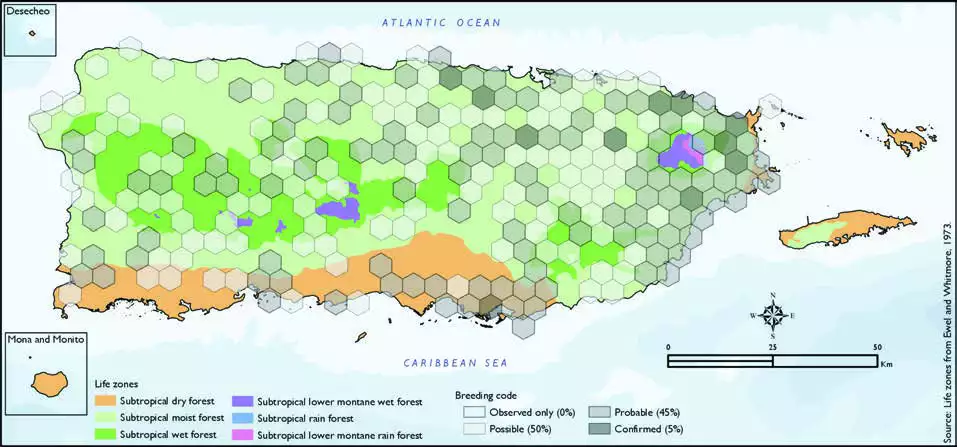
and others 1998). The atlas
fieldwork yielded a total of 375
records within 233 hexagons
or 49 percent of the 479 total
hexagons (see map). Of the 233
hexagons where this species
was found, breeding met the
atlas definition of confirmed in
5 percent (11) of the hexagons,
probable in 45 percent (106),
and possible in 50 percent (116)
(see map). Orange-cheeked Waxbill distribution. The map shows the highest breeding code by hexagon and overlaying the ecological life
zones in Puerto Rico. Note: percentages may not total 100 due to rounding.
Breeding Habits
The Orange-cheeked Waxbill appears to breed from June to
August, according to previously
published reports (Raffaele and
others 1998). The nest is made
of both thick and fine grasses, 239Orange-cheeked Waxbill/Veteranoand is usually built at ground level in the base of grass clumps
(Biaggi 1997, Raffaele and others
1998). Atlas results show that
this species breeds throughout
the year with the most breeding
activity from March to July (see
chart). The breeding activity
peaks in June, and it mostly
takes place within the subtropical
moist forest life zone (see chart).
Results suggest that this species
breeds throughout the island but
mostly within the subtropical
moist forest life zone (68 percent
of the hexagons) (see table). It
also breeds in subtropical wet
and lower montane wet forest life zones at higher elevations (18
percent of the hexagons), and
in the southern region within
the subtropical dry forest life
zone as well (14 percent of the
hexagons) (see table and map).
Conservation
The global population size of the Orange-cheeked Waxbill has
not been quantified or assessed,
but the species is described as
common or locally common
to abundant (Clement 1999).
Due to the lack of evidence
for any declines or threats, the
current population trend is
suspected to be stable, and it is currently listed as a species
of least concern by the IUCN
(BirdLife International 2018).
In Puerto Rico, nests of the
Orange-cheeked Waxbill have
been found to be parasitized by
the nonnative Pin-tailed Whydah
(Raffaele 1989b). Locally, this
species is not listed in any of the
threatened categories of PRDNER
and USFWS. In Puerto Rico, the
Orange-cheeked Waxbill has a
protected habitat in land of 10
percent or 543 km2 of the total area covered by the hexagons
where evidence of beeding
was found for this species
(5570 km2).
Related Species
Family:
finch