Puerto Rican Vireo
Description
The Puerto Rican vireo (Vireo latimeri) is a small bird endemic to the archipelago of Puerto Rico and one of the 31 species belonging to the genus Vireo of the family Vireonidae. Its local name is bien-te-veo ("see-you-well", after the call), not to be confused with the unrelated great kiskadee - also known as bien-te-veo - which is found elsewhere.
Distribution & Habitat
The Puerto Rican Vireo is endemic in Puerto Rico and
widespread and common
throughout forest habitats at
all elevations, except in the
east where it is uncommon
or rare (Oberle 2018, Raffaele
1989a). The species is usually
associated with montane forests,
coffee plantations, coastal karst
limestone, and thorn forests
with vine tangles (Oberle 2018).
It has also been reported in
the haystack hills of the north
coast and among the hills of the
south coast (Faaborg and others
1997, Raffaele 1989a). Only an
unconfirmed record of the vireo
exists for Vieques (Gemmill
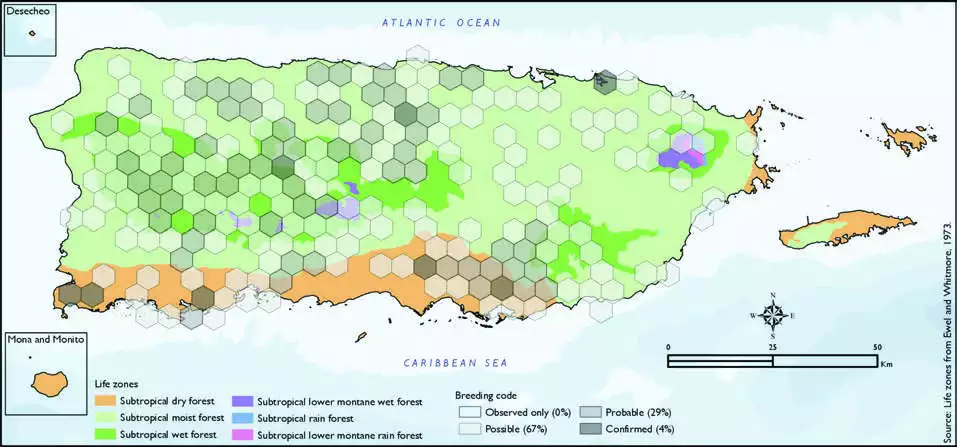
2015). The atlas fieldwork
yielded a total of 362 records
within 210 hexagons or 44 percent of the 479 total hexagons
(see map). Of the 210 hexagons
where this species was found,
breeding met the atlas definition
of confirmed in 4 percent (8) of
the hexagons, probable in 29
percent (61), and possible in 67
percent (141) (see map). Puerto Rican Vireo distribution. The map shows the highest breeding code by hexagon and overlaying the ecological life zones in
Puerto Rico. Note: percentages may not total 100 due to rounding.
Breeding Habits
The Puerto Rican Vireo makes a deep cup-shaped nest made
of grass, twigs, moss, and other
vegetation, usually in the fork of
branches. Previously published
reports indicate that construction
of the nest begins in March and
peaks in May, with the juveniles
fl edging in June (Raffaele and
others 1998). Atlas results show
that this species breeding
season extends throughout the
year with the most breeding 215Puerto Rican Vireo/Bienteveoactivity from March to June (see chart). Results show that this
species breeds mostly within the
subtropical moist forest life zone
(53 percent of the hexagons),
and in the subtropical wet and
lower montane wet forest life
zones at higher elevations (30
percent of the hexagons) (see
table and map). However, results
show that it also breeds in the
coastal plains of the southern
region within the subtropical dry
forest life zone (17 percent of the
hexagons) (see table and map).
Conservation
The population trend for the Puerto Rican Vireo has not been quantified or assessed,
but it is described as fairly
common (Stotz and others
1996). This species is currently
listed as a species of least
concern by the IUCN (BirdLife
International 2016). However,
a current major threat is nest
parasitism by the Shiny Cowbird
(Molothrus bonariensis), which
has been shown to reduce
breeding success especially in
the subtropical dry forest in
Guánica (Faaborg and others
1997, Woodworth 1997) and
perhaps elsewhere in the
lowlands. However, cowbird
parasitism is less of a threat
to the Puerto Rican Vireos breeding in the montane forests
of Maricao (Tossas 2008),
which may serve as a source
population to maintain the
heavily parasitized populations
(sink populations) in the
lowlands (Tossas 2002). Locally,
this species is not listed in any
of the threatened categories of
PRDNER and USFWS. In Puerto
Rico, the Puerto Rican Vireo has
a protected habitat in land of 16
percent or 810 km2 of the total area covered by the hexagons
where evidence of breeding
was found for this species
(5025 km2).
Related Species
Family:
vireo