Glossy Ibis
Description
The glossy ibis (Plegadis falcinellus) is a water bird in the order Pelecaniformes and the ibis and spoonbill family Threskiornithidae. The scientific name derives from Ancient Greek plegados and Latin, falcis, both meaning "sickle" and referring to the distinctive shape of the bill.
This species is a mid-sized ibis. It is 48–66 cm (19–26 in) long, averaging around 59.4 cm (23.4 in) with an 80–105 cm (31–41 in) wingspan.[12][13] The culmen measures 9.7 to 14.4 cm (3.8 to 5.7 in) in length, each wing measures 24.8–30.6 cm (9.8–12.0 in), the tail is 9–11.2 cm (3.5–4.4 in) and the tarsus measures 6.8–11.3 cm (2.7–4.4 in).[13] The body mass of this ibis can range from 485 to 970 g (1.069 to 2.138 lb).[13] Breeding adults have reddish-brown bodies and shiny bottle-green wings. Non-breeders and juveniles have duller bodies. This species has a brownish bill, dark facial skin bordered above and below in blue-gray (non-breeding) to cobalt blue (breeding), and red-brown legs. Unlike herons, ibises fly with necks outstretched, their flight being graceful and often in V formation. It also has shiny feathers.
Distribution & Habitat
The Glossy Ibis occurs worldwide including the West
Indies, where it is irregular
and very local in Puerto Rico
(Raffaele and others 1998).
Before the early 2000s, this
species was considered a rare
visitor until it was confirmed to
be nesting in the municipality
of Arecibo (J.A. Salguero-Faría,
personal observation 2009). It
has expanded throughout coastal
wetlands and now can be seen
in fl ocks that number hundreds
of birds (J.A. Salguero-Faría,
personal observation 2009).
This species occurs in lowland
habitats (Oberle 2018) including
mud fl ats and marshy savannas (Raffaele and others 1998). The
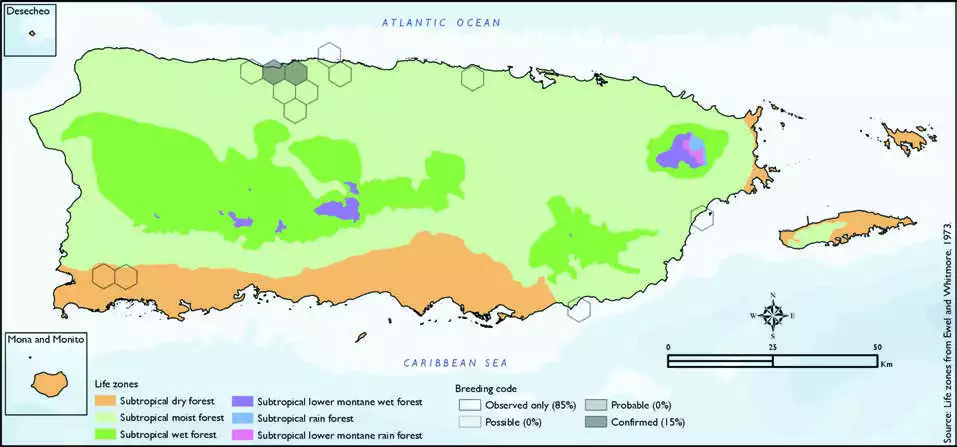
atlas fieldwork yielded a total of
27 records within 13 hexagons
or 3 percent of the 479 total
hexagons (see map). Of the 13
hexagons where this species
was found, breeding met the
atlas definition of confirmed in
15 percent (2) of the hexagons,
while the species was observed
in 85 percent (11) of the
hexagons but without evidence
of breeding (see map). Glossy Ibis distribution. The map shows the highest breeding code by hexagon and overlaying the ecological life zones in
Puerto Rico. Note: percentages may not total 100 due to rounding.
Breeding Habits
The Glossy Ibis nests in colonies and constructs the nest near
water, principally from June to
August, according to previously
published reports (Raffaele and 165Glossy Ibis/Ibis Lustrosoothers 1998). The two instances of reported Glossy Ibis breeding
in Puerto Rico occurred in
the month of June (see chart).
Results show that the Glossy Ibis
breeds within the subtropical
moist forest life zone (100
percent of the hexagons) (see
table and map).
Conservation
The population trend for the Glossy Ibis across its distribution
range is described as decreasing, mainly due to wetland habitat
degradation and loss, but it
is listed as a species of least
concern by the IUCN (BirdLife
International 2019). Locally, this
species is listed as Data Deficient
(PRDNER 2015). In Puerto Rico,
the Glossy Ibis has a protected
habitat in land of 15 percent or
7 km2 of the total area covered by the hexagons where evidence
of breeding was found for this
species (~48 km2).
Related Species
Family:
threskiornithidae