Tricolored Heron
Description
The tricolored heron (Egretta tricolor), formerly known as the Louisiana heron, is a small species of heron native to coastal parts of the Americas; in the Atlantic region, it ranges from the northeastern United States, south along the coast, through the Gulf of Mexico and the Caribbean, to northern South America as far south as Brazil. In the Pacific region, it ranges from Peru to California, but it is only a nonbreeding visitor to the far north.
This species measures from 56 to 76 cm (22 to 30 in) long and has a typical wingspan of 96 cm (38 in). The slightly larger male heron weighs 415 g (14.6 oz) on average, while the female averages 334 g (11.8 oz). It is a medium-large, long-legged, long-necked heron with a long, pointed, yellowish or greyish bill with a black tip. Its legs and feet are dark.
Distribution & Habitat
The Tricolored Heron occurs from North America to northern
South America including the
West Indies (Raffaele and others
1998). It is a common permanent
resident in Puerto Rico (Oberle
2018). It is also present on
Vieques (Sorrié 1975), where it
is a common resident in winter
and spring, fairly common in
fall, and uncommon in summer
(Gemmill 2015). It usually
inhabits saltwater lagoons,
mangrove swamps, estuaries,
shallow coastal waters (Oberle
2018), and freshwater wetlands
(Raffaele and others 1998). The
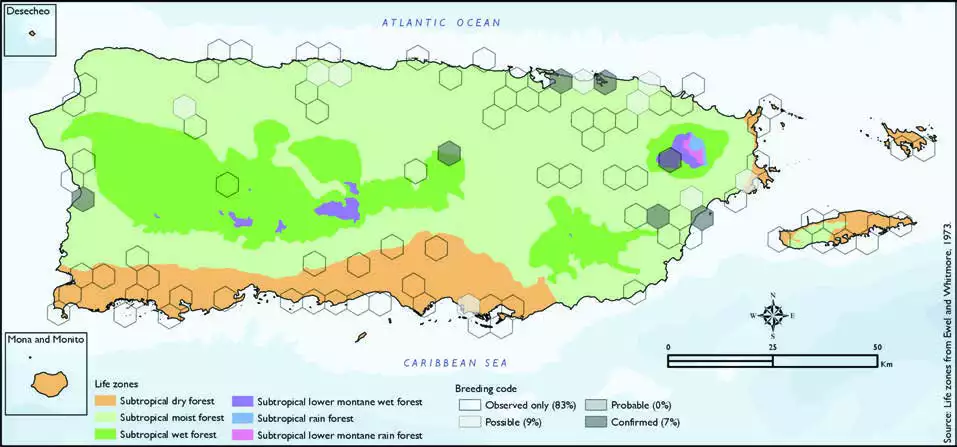
atlas fieldwork yielded a total of 143 records within 95 hexagons
or 20 percent of the 479 total
hexagons (see map). Of the 95
hexagons where this species
was found, breeding met the
atlas definition of confirmed in 7
percent (7) of the hexagons and
possible in 9 percent (9), while
the species was observed in 83
percent (79) of the hexagons but
without evidence of breeding
(see map). Tricolored Heron distribution. The map shows the highest breeding code by hexagon and overlaying the ecological life zones in
Puerto Rico. Note: percentages may not total 100 due to rounding.
Breeding Habits
Previously published reports indicate that the Tricolored
Heron breeds from April to
July (Raffaele and others 1998)
and is often colonial with other 153Tricolored Heron/Garza Pechiblancaheron species (Biaggi 1997, Raffaele and others 1998). The
nest is usually constructed on a
bush or tree limb at a moderate
height and consists of a platform
made mostly of sticks (Biaggi
1997, Raffaele and others 1998).
Atlas results suggest that this
species breeds mostly from
March to September with the
most breeding activity in March,
April, and July, and to a lesser
extent also during December and
January (see chart). Results show
that this species breeds mostly within the subtropical moist
forest life zone (88 percent of the
hexagons), and it also breeds in
the subtropical wet and lower
montane wet forest life zones
at higher elevations (6 percent
of the hexagons) (see table
and map).
Conservation
The overall population trend of the Tricolored Heron is
described as stable. However,
some populations have unknown trends (Wetlands International
2012). This species is currently
listed as a species of least
concern by the IUCN (BirdLife
International 2016). Locally, this
species is not listed in any of the
threatened categories of PRDNER
and USFWS. In Puerto Rico, the
Tricolored Heron has a protected
habitat in land of 18 percent or
69 km2 of the total area covered by the hexagons where evidence
of breeding was found for this
species (382 km2).
Related Species
Family:
heron