Snowy Plover (Charadrius nivosus)


Snowy Plover
Description
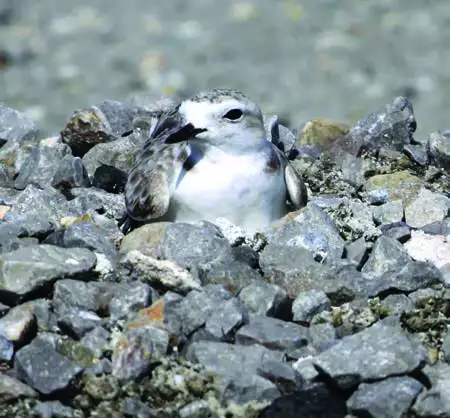
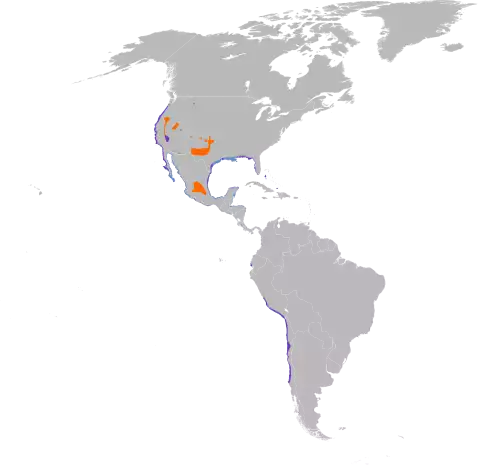
The snowy plover (Charadrius nivosus) is a small wader in the plover bird family, typically about 5-7" in length. It breeds in Ecuador, Peru, Chile, the southern and western United States and the Caribbean. Long considered to be a subspecies of the Kentish plover, it is now known to be a distinct species.
Distribution & Habitat
The Snowy Plover ranges from the Western and Southern United States to northern and western South America and the Caribbean (Raffaele and others 1998). Within the Caribbean, it occurs commonly in the southern Bahamas north to San Salvador, and in Hispaniola and Anguilla, while it is considered uncommon in the northern Bahamas, Puerto Rico, the Virgin Islands, St. Martin, and St. Barthélemy, and very rare on Cuba (Raffaele and others 1998). It is an uncommon and localized permanent resident in Puerto Rico (Oberle 2018, Raffaele and others 1998), limited to the extreme southwestern corner of the main island, where it can be regularly seen in the salt fl ats of Cabo Rojo. The species has not been recorded from Vieques (Gemmill 2015), and only one published record exists for Culebra, at least at the time of publication of the field guide by Raffaele and others (1998). This species habitat includes mostly sandy beaches and lagoon edges with salt fl ats or salt ponds (Oberle 2018, Raffaele and others 1998). The atlas fieldwork yielded a total of 14 records within three hexagons or 0.6 percent of the 479 total hexagons (see map). Of the three hexagons where this species was found, breeding met the atlas definition of confirmed in 33 percent (one) of the hexagons and possible in 33 percent (one) as well, while the species was observed in 33 percent (one) of the hexagons but without evidence of breeding (see map). Snowy Plover distribution. The map shows the highest breeding code by hexagon and overlaying the ecological life zones in Puerto Rico. Note: percentages may not total 100 due to rounding. 109Snowy Plover/Chorlito Blanco
Breeding Habits
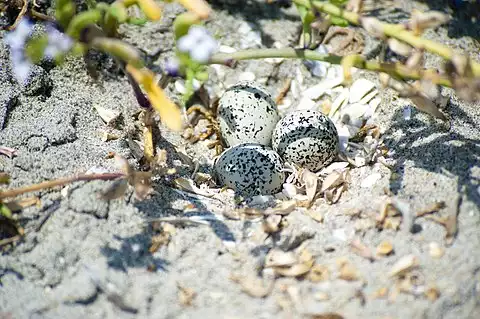
The Snowy Plovers nest consists of a depression made in the sand, sometimes bordered with shell pieces (Biaggi 1997, Oberle 2018, Raffaele and others 1998), and it generally nests in small colonies (Biaggi 1997). Previously published reports indicate that it breeds from January to August (Raffaele and others 1998). Atlas results based on small sample size show that this species breeds mostly from October to December but also during the months of March, May, June, and August (see chart). Overall, the breeding activity peaks in October and takes place in coastal areas within the subtropical dry forest life zone (100 percent of the hexagons) (see table and map).
Conservation
The current population trend of the Snowy Plover is described as decreasing throughout the Western Hemisphere following evidence of regional declines and due to ongoing threats like habitat degradation and disturbance (Page and others 2009, Thomas and others 2012). This species is currently listed as a Near Threatened species by the IUCN (BirdLife International 2017), and locally it is classified as critically endangered (PRDNER 2016). In Puerto Rico, the Snowy Plover has a protected habitat in land of 21 percent or 10 km2 of the total area where evidence of breeding was found for this species (48 km2). However, this value represents an underestimation of the actual terrestrial habitat protected (estimated to be about 80100 percent) as a large portion of the hexagons for this species lay on the water.
Related Species
Family: plover